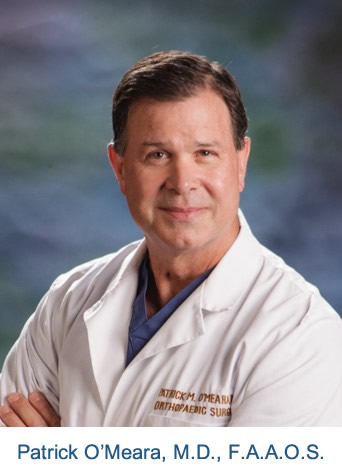
Patrick O'Meara, M.D., F.A.A.O.S.
Board Certified

Dr. O'Meara established his private practice in Escondido and founded Palomar Orthopaedic Specialists in 1992. He was recruited to the area by Palomar Medical Center to provide state-of-the-art orthopaedic services to patients within the Palomar Pomerado Health District.

Dr. O'Meara has distinguished himself as an authority in orthopaedic surgery. He has authored a multitude of scientific articles that have appeared in a wide variety of orthopaedic journals.

Education:
Chairman of the Department of Orthopaedic Surgery, Medical School: USC School of Medicine
Chairman of the Department of Orthopaedic Surgery, Orthopaedic Residency: University of Kansas - Wichita
Chairman of the Department of Orthopaedic Surgery, Sports Medicine: The Campbell Clinic - Memphis
 
Leadership Positions:
Chairman of the Department of Orthopaedic Surgery,
Chairman of the Department of Orthopaedic Surgery, Palomar Medical Center
Voluntary Clinical Instructor, University of Califonia, San Diego Voluntary Clinical Instructor, UCSD
Founder and President of Palomar Orthopaedic Trauma Founder and President of Palomar Orthopaedic Trauma Associates, LLC.
Member of the Joint Medical-Legal Commission Member of the Joint Medical-Legal Commission of the San Diego County Medical Society
Delegate of the California Medical Association Delegate of the California Medical Association
 
Patrick O'Meara, M.D., F.A.A.O.S. Board Certified.


ARTHROSCOPIC SURGERY

Arthroscopy is an advanced surgical procedure that utilizes a small fiberoptic camera in combination with small surgical tools (about the size of a pencil) to examine and repair a joint through small incisions. Many problems or injuries of the shoulder, knee, and ankle can be treated and cured through arthroscopic surgery.


[BACK TO TOP]


LIGAMENT RECONSTRUCTION

Anterior Cruciate Ligament (ACL) Reconstruction requires extreme accuracy and precision. The success of the procedure is also very dependent on proper post-op rehabilitation.

Dr. O'Meara is a published authority on the proper techniques for surgical reconstruction and rehabilitation following ACL injury.

.Download Rehab Protocol - ACL Reconstruction

To open in your browser, left-click.
To save to your computer, right-click and choose "Save As..."

[BACK TO TOP]


MENISCUS REPAIR

A Meniscus Tear is the most common intra-articular injury of the knee. The meniscus is the primary shock-absorber of the knee and its preservation is crucial to prevent premature degeneration of the knee. Dr. O'Meara is a published authority on meniscus repair. The surgical technique that Dr. O'Meara utilizes provides a 20% higher success rate over traditional methods.

Download Rehab Protocol - Isolated Meniscus Repair

To open in your browser, left-click.
To save to your computer, right-click and choose "Save As..."

[BACK TO TOP]

SHOULDER SURGERY

Most shoulder problems are biomechanical problems that respond well to a proper rehabilitation program. Occasionally, surgery is required to resolve a shoulder problem or repair a shoulder injury. Shoulder surgeries include arthroscopy, rotator cuff repair, shoulder reconstruction and shoulder replacement.

Download Rehab Protocol - Partial Rotator Cuff Tears and Rotator Cuff Bursitis

Download Rehab Protocol - Rotator Cuff Repair

To open in your browser, left-click.
To save to your computer, right-click and choose "Save As..."

[BACK TO TOP]


ARTHRITIS

Through many years of wear and tear on a joint, degenerative arthritis can develop. Arthritis causes pain, stiffness and loss of function. Dr. O'Meara provides all forms of treatment for arthritis, including medication, rehabilitation, intra-articular injections, arthroscopic surgery and total joint replacement.

[BACK TO TOP]


TOTAL JOINT REPLACEMENT

Over time, an active lifestyle can lead to the development of arthritic destruction of the joints. This can cause stiffness, pain and loss of function. Once a joint has "worn out" and shows advanced degenerative joint disease, Dr. O'Meara can replace the damaged joint to relieve the pain and improve function so the patient can become active again. Joints commonly treated include shoulders, hips and knees.

[BACK TO TOP]


SPORTS MEDICINE

Sports medicine involves the treatment, rehabilitation and prevention of athletic-related injuries. Dr. O'Meara understands how important it is for athletes to return to action as quickly and safely as possible. His treatment programs are designed to allow the athlete to remain physically active during recovery and to allow a rapid but safe return to competition.

[BACK TO TOP]


FRACTURES/ SPRAINS

Injuries and accidents do occur from time to time. Dr. O'Meara is well-trained in treating complex fractures and sprains.

Download Rehab Protocol - Ankle Sprain

To open in your browser, left-click.
To save to your computer, right-click and choose "Save As..."

[BACK TO TOP]


KNEE PAIN

Anterior Knee Pain or Patellofemoral Syndrome is the most common cause of non-traumatic knee pain. Only rarely is this caused by an anatomic malalignment which requires surgical correction. In the vast majority of cases, this is a non-operative problem which will resolve if treated with a well-structured rehabilitation program to improve the biomechanics of the knee. Dr. O'Meara has developed an "Anterior Knee Pain Rehab Protocol" which has produced an extremely high success rate in treating this problem.

Download Rehab Protocol - Anterior Knee Pain
(Patellofemoral Syndrome)

To open in your browser, left-click.
To save to your computer, right-click and choose "Save As..."

[BACK TO TOP]


LESIONS OF THE CARTILAGE

Isolated Lesions of the Cartilage surface of the knee can occur as a result of trauma, degeneration or osteochondritis dissecans. Surgical techniques are available.


[BACK TO TOP]


IMPINGEMENT/ TENDONITIS/ BURSITIS

The Rotator Cuff or the Subacromial Bursa can become irritated and inflamed by either an acute shoulder strain or through overuse. Early treatment utilizes anti-inflammatory medications, activity modification and a structured exercise program to achieve resolution of the inflammation and pain. If the problem is allowed to persist and become a chronic condition, it may become refractory to conservative treatment and require surgical intervention (e.g. arthroscopic subacromial decompression).

Download Rehab Protocol - Partial Rotator Cuff Tears and Rotator Cuff Bursitis

[BACK TO TOP]


ROTATOR CUFF TEAR

The Rotator Cuff is the primary muscular unit that provides stability and function to the shoulder. It is crucial for the shoulder to maintain an intact Rotator Cuff. Partial tears may, at times, heal without surgical intervention but full thickness tears almost always require prompt surgical repair. Partial tears and full thickness tears can be treated with arthoscopic surgery. A diligent rehabilitation program is required after surgery but an excellent outcome can be expected following a successful repair.

Download Rehab Protocol - Rotator Cuff Repair

To open in your browser, left-click.
To save to your computer, right-click and choose "Save As..."

[BACK TO TOP]


FROZEN SHOULDER

Spontaneously or following an injury, the shoulder can become stiff and painful. The capsule around the joint becomes contracted and limits the motion of the shoulder just like an undersized tight shirt. However, unlike a tight shirt, adhesive capsulitis is accompanied by pain. Early treatment involves physical therapy to stretch out and release the adhesions. Resistant cases require the shoulder to be manipulated under anesthesia or require surgical release of the adhesions. As soon as your range of motion is restored, the pain resolves.

[BACK TO TOP]


WORKERS' COMPENSATION

Patrick M. O'Meara, MD is a qualified medical evaluator (QME) for The Industrial Medical Council of the State of California. He has established a comprehensive workers' compensation division at Palomar Orthopaedic Specialists to help claims experts perform their jobs more easily and efficiently.

Highlights of his workers' compensation services include:


Dr. O'Meara understands the benefits of "Early Return to Work" Programs and he utilizes work restrictions/ modifications in order to allow patients to continue working, within safe parameters, while recovering from their industrial injuries.

Dr. O'Meara takes a very thorough history of injury and he analyzes the mechanism of injury in order to better evaluate the patient's disability and to better define the extent to which the injury was related to industrial activities.

Dr. O'Meara's reports include a detailed discussion which explains the medical findings that support his diagnosis and treatment recommendations.

[BACK TO TOP]